Anna secretly surveils her neighbors
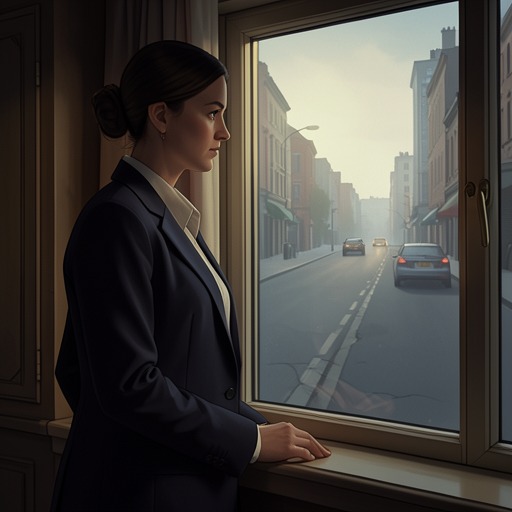
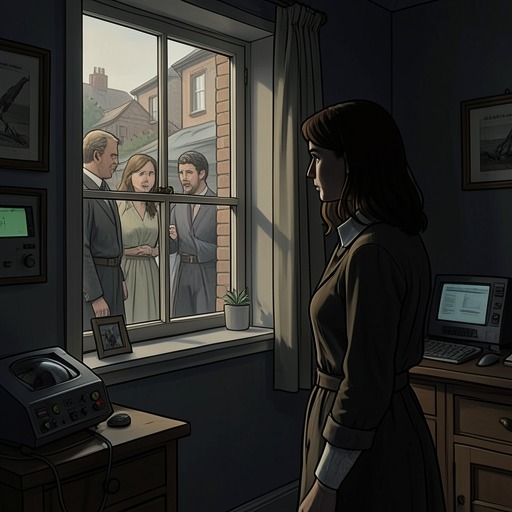
The Woman in the WindowAnna secretly surveils her neighbors by turning her windows and camera into instruments of observation. From inside her home, she watches private routines across the street, sometimes recording what she sees and sometimes choosing not to intervene. The practice offers a way to follow the world beyond her windows, but its accumulated images eventually confront her with the people—and the life—she has treated as objects of looking.
The Window as a Vantage Point
Anna’s observations range from houses to sidewalks, and from passing strangers to intimate domestic scenes. At number 212, she watches a woman and a contractor enter a guest bedroom. The house has no curtains or blinds, and Anna follows the couple’s movements from across the street. She knows enough about the property’s former occupants to note that the Motts were newlyweds who later separated, and she has checked their online profiles and lingering wedding registry. A house that once represented their marriage now appears to her as a place where love has died.
When she sees the woman and contractor disrobing, Anna considers calling the house to warn her. She decides against it, treating watching as a kind of nature photography in which the observer should not disturb the scene. The choice reveals a boundary she sets for herself: she may look closely, even as the people watched remain unaware, but she casts nonintervention as a rule that makes the looking seem passive. The husband, Dr. John Miller, is approaching the house, and Anna tracks his progress as he walks, noting his polished shoes and the details visible through her camera lens. The scene’s countdown makes the distance between observation and possible intervention feel especially narrow.
The Camera and Its Routine
Anna’s surveillance is not limited to moments of scandal. Early one morning, after watching a film late the previous night, she sees a rangy teenager burst from number 207 with a backpack over one shoulder. She catches only a flash of blond hair before he disappears down the street. After drinking a glass of merlot, she goes upstairs and reaches for her Nikon D5500.
From her desk, she aims the camera at the kitchen of number 207. The father inside is backlit by a television showing the Today show. Anna considers turning on her own television, then chooses to watch his screen through the camera instead. A street view helps her orient herself to the house’s whitewashed stone façade and widow’s walk; from her position, its east-facing windows give her a view into the kitchen, a second-floor parlor, and a bedroom above. The camera does not merely record a scene: it gives her a route into rooms she cannot enter.
The practice recurs as an organized domestic ritual. With a tumbler in one hand and her camera in the other, Anna settles between the south- and west-facing windows and surveys the neighborhood. She sees Rita Miller returning from yoga, smiling with a phone to her ear, and wonders who is on the other end. She also observes Mrs. Wasserman and Henry leaving their home, and pedestrians pausing outside another house. Her view moves readily from neighbors she recognizes to strangers she invents possible conversations for, making the neighborhood into a succession of scenes available to her lens.
The Archive of Other People’s Lives
Anna describes a long period of photographing the world beyond her window. She has taken pictures of neighbors, strangers, and the postman, whom she once photographed at every door. For months, she pored over those images and relived the moments they captured. Eventually, she says, she could no longer keep up with the world beyond the window. The photographs thus serve both as a record of activity and as a substitute for being present in it.
The archive contains small gestures as well as larger signs of feeling: a boy playing cello with his eyes closed and fingers trembling on the strings; the Grays raising wineglasses in a toast; Mrs. Lord lighting candles on a cake; and the Motts arguing from opposite ends of a red parlor, with a vase broken between them. Anna’s camera turns such episodes into images she can revisit, flattening celebration, private strain, and ordinary movement into material stored on her hard drive. The collection’s scale matters to her: she imagines the drive swollen with images she has taken without the subjects’ knowledge.
Exposure and Reversal
The routine breaks when Anna’s camera falls to the floor and she flees into the dark stairwell. Until then, she has thought of herself as uncaught: she recalls watching the Millers and other neighbors, people who have since moved away, passersby, and even the postman without being discovered. But the thought of Jane Russell looking at her unblinkingly across the park unsettles that assumption. Anna’s position is no longer simply that of an invisible observer.
Shame brings the archive back to her in a rush. She thinks of kisses, crises, chewed nails, dropped change, strides, and stumbles, as well as the particular scenes preserved on her camera. The shift is not that the images disappear, but that Anna recognizes the exposure implicit in having made them: she is alive, visible, and capable of being watched in turn. Her surveillance has organized the neighborhood around her gaze; Jane’s returned look makes that arrangement unstable. The camera that enlarged other people’s private lives has also made Anna confront her own presence at the window.